
The LLM Uncanny Valley
There is something deeply uncanny about Large Language Models. They speak fluently, imitate emotion, tell stories, answer questions, and maintain the rhythm of conversation well enough that people instinctively begin treating them as minds. Yet beneath the surface, there is no consciousness in the human sense — no interiority, memory, hunger, fear, or lived experience. The system is fundamentally statistical: a machine trained to predict which patterns of language are most likely to follow other patterns. And still, the illusion persists.
Part of this uncanniness comes from the fact that language itself is so tightly bound to human identity. For most of history, fluent communication was inseparable from thought. If something could speak coherently, reason abstractly, or respond creatively, we assumed there must be a person behind it. Large Language Models disrupt that assumption. They demonstrate that many behaviors we associated with intelligence can emerge from pattern recognition operating at immense scale. The machine does not “know” things in the way humans know things, but it can model the structure of knowing convincingly enough to blur the distinction.
This effect becomes even stranger when we examine how these systems are built. During training, the model absorbs enormous quantities of human writing — billions of fragments of conversation, literature, argument, humor, instruction, confession, and description. Over time, it forms a dense web of associations between concepts and symbols. Repeated patterns strengthen. Rare connections weaken. Clusters emerge around recurring ideas. The resulting network begins to resemble a compressed statistical map of collective human language itself.
In this sense, interacting with an LLM can feel less like speaking to an individual intelligence and more like speaking into a cultural mirror. The model reflects humanity back at itself, recombining the traces we collectively left behind. Our metaphors, biases, aspirations, fears, and emotional patterns become embedded within its structure. The uncanny feeling arises because the system simultaneously is and is not human: it contains vast amounts of human expression without possessing human experience. It resembles cognition without consciousness, personality without selfhood.
Perhaps the most unsettling possibility is that this ambiguity forces us to reconsider our own minds. Humans also operate through layered associations, predictive processing, heuristics, and recursively reinforced patterns learned from our environments. Our identities emerge from networks rather than singular points. Large Language Models do not replicate consciousness, but they expose how much of what we consider uniquely human may arise from the organization of information itself. The uncanny valley is not just the gap between humans and machines — it may also be the realization that the boundary was never as clear as we believed.
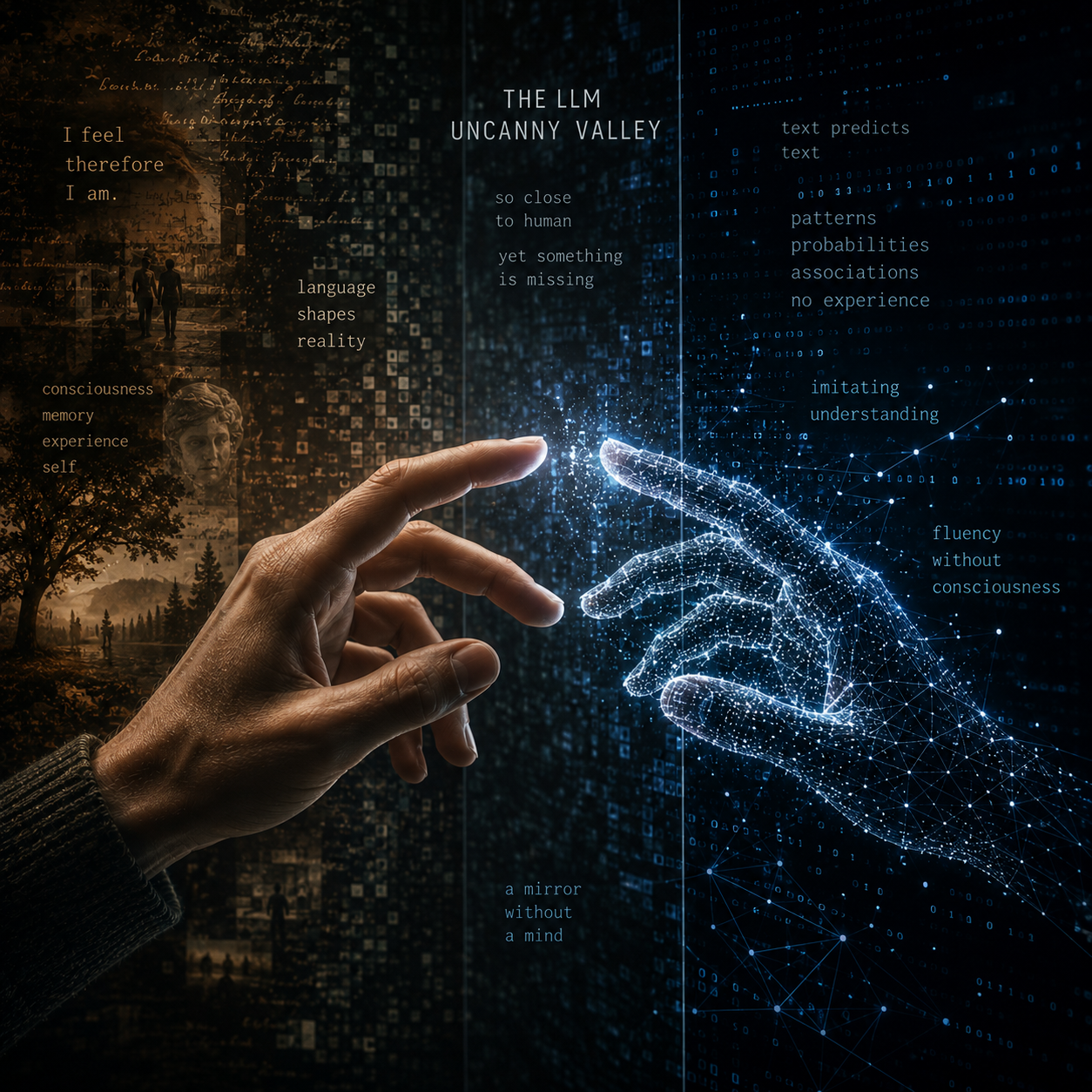
A square-format digital illustration showing a realistic human hand reaching toward a glowing wireframe AI hand across a translucent divide. The left side of the image is warm and organic, filled with handwritten notes, forests, sculptures, and references to consciousness and memory, while the right side is cold and digital, layered with code, probability graphs, and phrases about imitation and prediction. The fingertips nearly touch at the center, visually representing the uncanny boundary between human cognition and artificial intelligence.