Random Forest
One of the most effective machine learning techniques is called a “Random Forest.”
Instead of relying on a single decision tree, the system generates hundreds or thousands of small trees independently. Each tree makes imperfect predictions based on limited information. Some are shallow. Some are biased. Some miss obvious patterns entirely.
But together, the forest becomes remarkably accurate.
This is one of nature’s favorite strategies: resilience through distributed intelligence. A real forest does not depend on a single perfect tree. Knowledge, nutrients, and adaptation emerge from diversity, redundancy, and overlapping systems. Failure at the individual level strengthens the ecosystem overall.
Human intelligence may work the same way. We like to imagine thinking as one clean, rational process, but cognition is probably closer to a noisy forest of competing signals, memories, intuitions, and heuristics. Any individual pathway can be wrong. The wisdom emerges from the network.
The machine learning metaphor accidentally loops back into biology:
the forest became intelligent because intelligence was already forest-shaped.
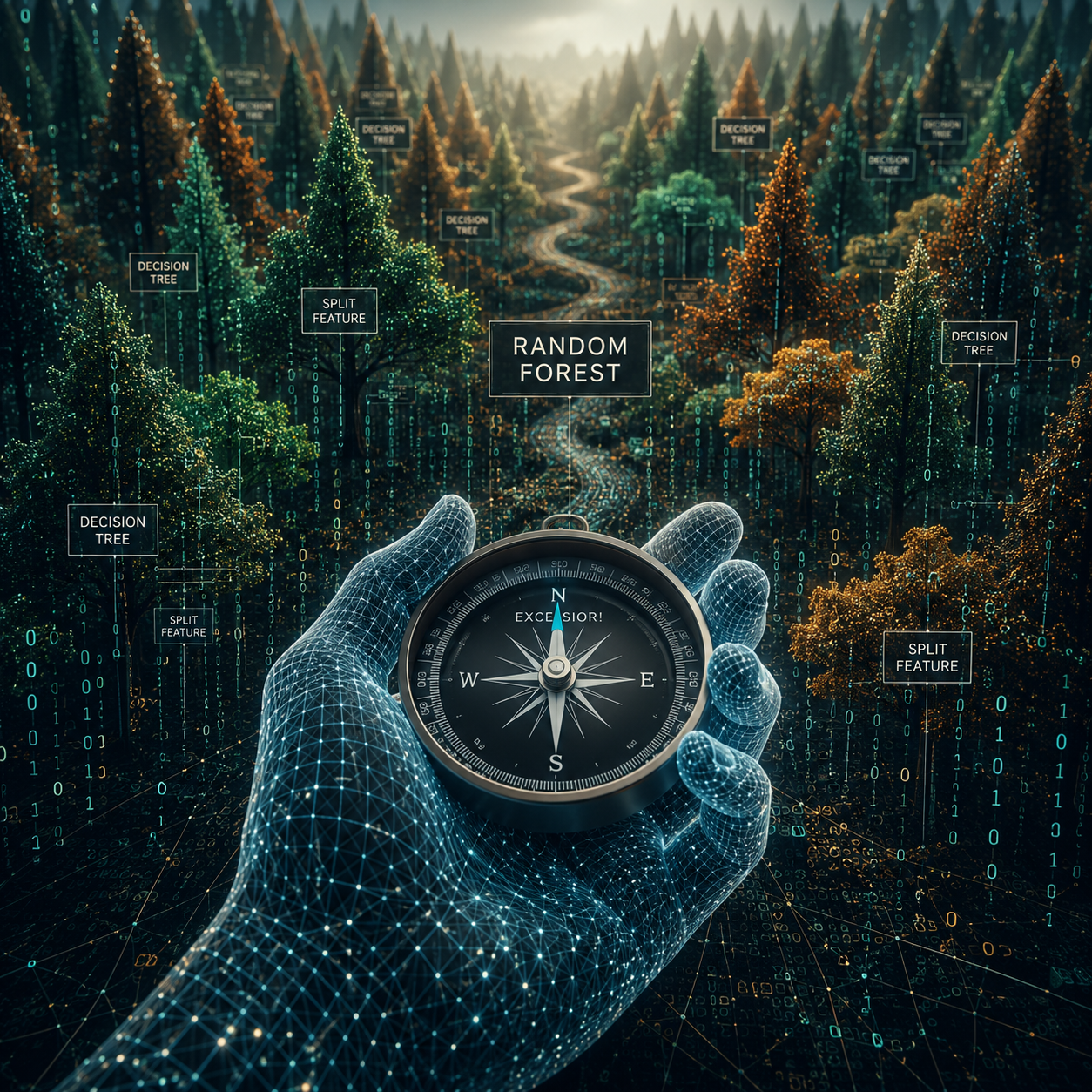
A glowing digital hand holds a brass compass labeled “Excelsior!” in the foreground of a dense, data-filled forest. The trees are overlaid with machine-learning terms like “decision tree” and “split feature,” while streams of binary code drift through the scene. A winding path disappears into the distance, blending natural forest imagery with futuristic network visualization to evoke the concept of a Random Forest algorithm.